
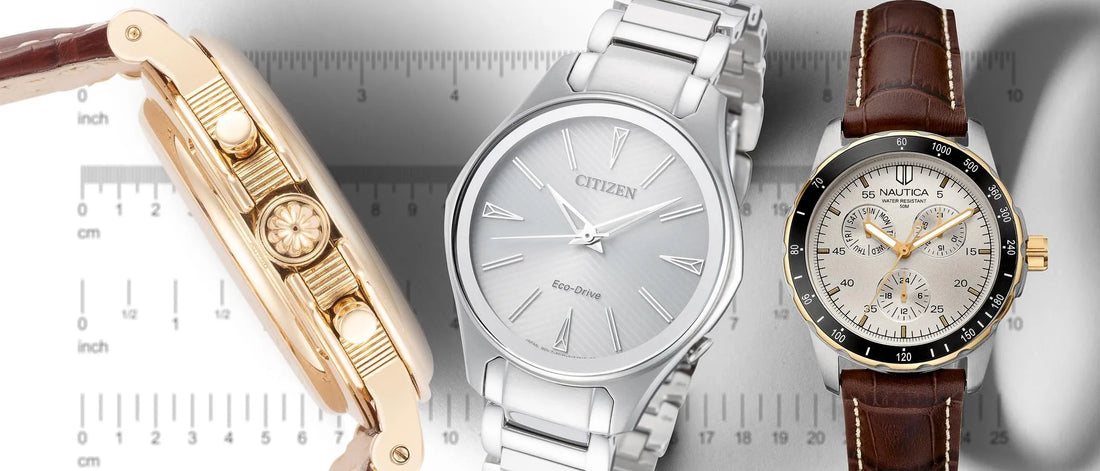
Watch Size Guide
The wristwatch is an iconic fashion piece that can add a touch of class and elegance to any outfit. There’s a perfect watch for every occasion, whether it’s for daily wear or for a formal occasion, and nothing makes a better accessory when chosen with care. This makes the aesthetics of your watch important, but there’s more that goes into just style and fashion when it comes to wearing watches. You also need to choose the right size watch for your wrist!
Don’t worry, though – while choosing the correctly-sized watch might seem like an esoteric and occult art, it’s really not. In fact, we have the perfect guide for you when it comes to finding the perfectly-sized watch for your wrist. Between the size of the case, its thickness, and the width of the watch band, and any other considerations you’ll need to keep in mind, we’ll go over what you need to know to size your next watch like a pro. Ready to discover what you’re looking for? Let’s get started!
Before we begin, let’s get a few things out of the way: larger wrists need larger watches, just as smaller wrists need smaller watches. This isn’t universal by any stretch of the imagination (we’ll get into that below) but for the most part, you’re not going to look your best if you’ve got a large wrist and you’re wearing a dainty watch. Likewise, if you’ve got a slender or delicate wrist, wearing a large watch is going to make you stand out, and not in a good way.
Remember that a wrist watch isn’t just a functional accessory – it’s one that is supposed to complement your personal sense of fashion and style. Formal events, for example, require formal accessories; everyday wear, by the same token, should keep function in mind as much as form. Is it possible to find a watch that you can wear in just about every situation? Absolutely! Does this require selecting a design that fits your wrist pretty precisely? You bet it does. Let’s start looking into how different sizes translate to different styles and aesthetics.
Watch Case Size
The diameter of the watch case itself is almost certainly the most important element when it comes to picking out a watch that’s appropriately sized for you. Watch case size differences are pretty broad, as the range of sizes for men’s watches start roughly at 38mm and go as large as 46mm, while women’s watches usually start at around 34mm to take into account that most women have more slender wrists. This doesn’t mean that slimline timepieces can’t be unisex – in fact, many classic or vintage wristwatches for men featured a watch case size of between 34mm and 36mm. This tradition continues today, though most men prefer watches with larger case sizes.
So how do you determine exactly what watch case size you need for you? Your best bet is to take a measurement of your wrist. Wrap a tailor’s tape measure around your wrist, or a piece of string and then measure it on a ruler. If your wrist circumference is between 6 to 7 inches, a watch case size of 38mm, 40mm or 42mm is ideal. If your wrist is larger, then a 44mm or 46mm watch case is a better fit for you; if it’s smaller, then a 34mm or 36mm watch case is likely to be a better fit.
| Wrist Circumference | Recommended Watch Case Size |
| up to 6 In. | 34mm, or 36mm |
| 6 -7 In. | 38mm, 40mm, or 42mm |
| 7 In. and up | 44mm, 46mm |
Watch Thickness
The overall size of your watch case isn’t the only thing to consider while choosing a watch of the appropriate size. The watch case width or thickness is also important to keep in mind! In general, watch case thickness increases with the diameter of a watch case size. small to medium case size diameters, for example, will usually have a watch case width of around 7mm.
Larger case sizes are often 9mm or thicker, though this depends on how complex the inner workings of the watch in question. If you’re considering an exhibition case back watch, for example, you’ll get some depth from the extra crystal. This isn’t a hard and fast rule, however, as each watch is different. In fact, many watch brands specialize in creating thinner complicated movements for an ultra-thin watch width, even with the inclusion of an exhibition case back. This means that you can get the best of both worlds if you’re looking for such!
Watch Band Width
Finally, we come to the last important component: the width of the watch band. When it comes to picking an appropriate watch strap width, you’ll need to keep in mind that a good rule of thumb is to choose a width that is roughly half the size of your watch case diameter. This means that you’ll need a watch strap width of around 22mm if you’re purchasing a 44mm watch, for example. This prevents your watch from looking out of proportion because the size of your watch strap is too large or too small.
Of course, the material of your watch band plays a role in this choice as well. A metal band is always going to look bigger and heavier than a fabric or a leather band type. If you have a larger sized wrist, you’re likely to get a better look and feel with a metal band as a result. Metal bands made from solid links are a bit heavier, but you can find a hollow link bracelet if you’re looking to cut down on weight. Meanwhile, fabric and woven straps are more utilitarian but offer a more varied number of looks. Likewise, leather straps are likely the best choice for a formal occasion, thanks to the look and feel of the material.
Other Important Factors
Watch case size, thickness, and strap width are all major factors when it comes to finding a watch that fits well and looks good. These aren’t always the only determining factors, however; every aspect of a watch can play a role, after all. Whether it’s the lug size, the pusher and changer, and even the size of the numbers and hands on the watch face itself are important factors. Even slight differences in the size of these details can alter the aesthetics of a watch, with larger-sized components easily making a watch look larger than it actually is. The reverse is true as well, which can often result in allowing you to wear a larger watch than you normally would be able to pull off otherwise.
This is why it’s so crucial to keep in mind all of these different components. If they’re complimentary with the other elements of the watch in ways that it’s proportionate, balanced, and attractive while it’s on your wrist, it’s most certainly a winner. Otherwise, you may be better off choosing a watch with different elements that better suit the size of your wrist. However, in the end, it truly does come down to personal preference. If you find a watch that compliments your wrist and matches your style, feel free to bend or even break these rules in order to complete the perfect look.